

Table of Contents
- Why Cold Water Is Non-Negotiable for High Performance Activewear
- The Best Laundry Detergent for Gym Clothes (and What to Avoid)
- Why You Shouldn't Use Fabric Softener on Activewear
- How to Remove Sweat Smell from Polyester
- Step-by-Step: How to Wash High Performance Activewear
- Microplastic Shedding: A Hidden Cost of Washing Synthetic Activewear
- Special Care for Compression Gear and High-Stretch Fabrics
- Stain Removal for Specific Sports and Laundry Room Setup
- Frequently Asked Questions
Last Updated: September 21, 2026
Why Cold Water Is Non-Negotiable for High Performance Activewear
Cold water is the single most important rule for washing high performance activewear. Heat breaks down the stretch fibers that make your gear fit and perform. Once those fibers go, the garment sags and loses its shape for good.

Cold water protects three things at once:
- The stretch that holds compression in place
- The moisture-wicking finish that pulls sweat off your skin
- The color, which fades fast in warm washes
The Best Laundry Detergent for Gym Clothes (and What to Avoid)
The best laundry detergent for gym clothes is a mild, enzyme-based formula. Enzymes break down the proteins and oils in sweat. That is what actually removes odor instead of just masking it.
Skip these:
- Regular detergents with heavy dyes and perfumes
- Bleach, which eats synthetic fibers
- Anything labeled "extra strength" for everyday loads
Why You Shouldn't Use Fabric Softener on Activewear
Fabric softener is the worst thing you can put on activewear. It coats fibers in a waxy film that blocks moisture-wicking. Your gear stops pulling sweat away and starts holding it.
Here is why you shouldn't use fabric softener on activewear, in plain terms:
- It clogs the wicking properties you paid for
- It locks in odor instead of releasing it
- It reduces breathability and elasticity over time
How to Remove Sweat Smell from Polyester
For deep-set smells, try laundry stripping once or twice a year. Soak gear in a tub of hot water with a scoop of detergent and a quarter cup of baking soda. Watch the water turn gray, then rinse and wash normally.
Step-by-Step: How to Wash High Performance Activewear
Here is the full process for how to wash high performance activewear, from sorting to drying. Follow these steps and your gear will last through hundreds of workouts.

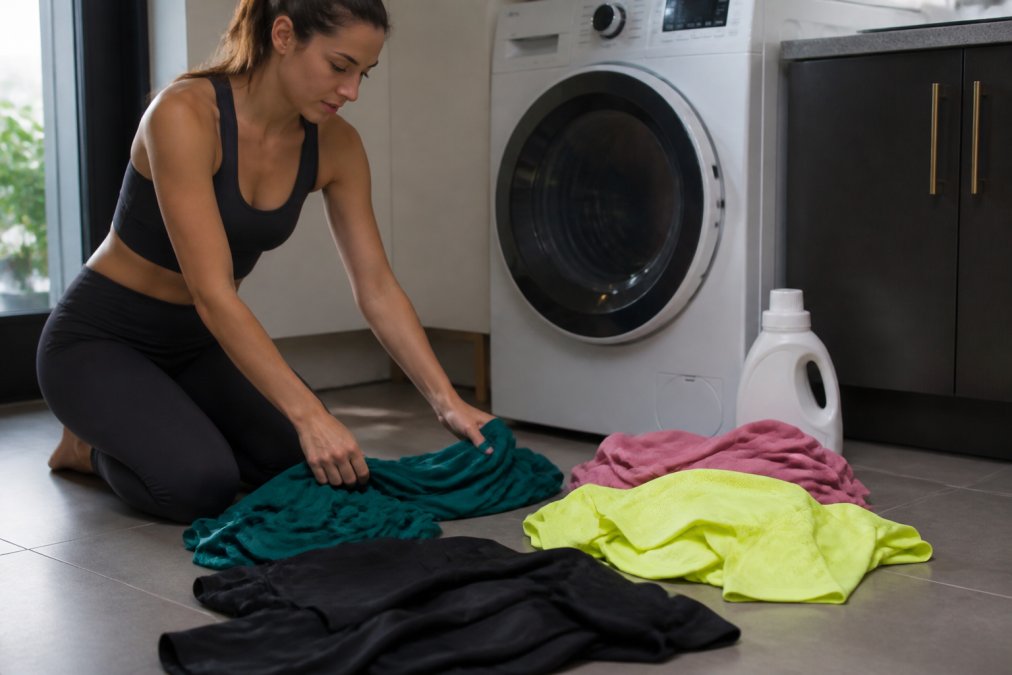
Step 1: Sort by Fabric and Color
Keep synthetics together and separate them from cotton. Cotton lint sticks to spandex and shows. Sort lights from darks to stop color bleed. Check pockets and close all zippers before the load.
Step 2: Pre-Soak Heavily Soiled Gear
Pre-soak anything with visible sweat stains or set-in odor. Use cold water and a cap of mild detergent for 30 minutes. This loosens oils before the main wash. A common mistake is skipping this step on gym gear, then wondering why the smell stays.
Step 3: Choose the Right Cycle and Load Size
Run a cold water cycle on the gentle setting. Keep the load small so clothes move freely and rinse clean. A packed machine cannot rinse out soap, and that residue causes odor. Add half a cup of distilled white vinegar to the rinse cycle.
Step 4: Air-Dry vs. Tumble Dry Low
Air-drying is the safest choice for high performance activewear. Hang gear to dry in the shade, away from direct heat. If you must use a machine, choose tumble dry low and pull items out slightly damp. High heat is what shrinks spandex and cracks prints.
| Method | Heat Level | Best For | Risk |
|---|---|---|---|
| Air-dry | None | All synthetics | None |
| Tumble dry low | Low | Thick fabrics | Mild wear |
| Tumble dry high | High | Never | Shrinks, cracks |
Microplastic Shedding: A Hidden Cost of Washing Synthetic Activewear
Every wash of synthetic gear releases tiny plastic fibers called microfibers into the water. These shed from polyester and nylon with each cycle. Cold water and shorter cycles reduce how many escape.
You can cut shedding with a few simple habits:
- Wash full loads less often instead of small frequent ones
- Use a wash bag designed to catch fibers
- Choose a gentle cycle over a long, aggressive one
- Air-dry instead of tumbling
Special Care for Compression Gear and High-Stretch Fabrics
Compression gear is engineered, not sewn. The pressure it delivers comes from elastane (spandex) fibers woven under tension, and those fibers behave very differently from the polyester around them. Treat a compression piece like a standard t-shirt and you shorten its useful life by a wide margin.
Why elastane fails
Elastane is a segmented polyurethane-urea fiber. Its stretch comes from soft, mobile segments that uncoil under load and snap back when tension releases. Two things break that mechanism:
- Heat. Warm water and dryer heat relax the hard segments that hold the fiber's memory. Once they relax, the fiber does not fully recover, and the garment stops holding pressure.
- Chlorine and oxygen bleach. Both attack the polymer backbone directly. A single bleach load can leave compression gear permanently slack.
- Mechanical stress. Wringing, twisting, and high-spin cycles stretch fibers past their recovery point. The damage is cumulative, not instant.
The wash routine that preserves elasticity
- Turn pieces inside out. This puts the abrasion of the drum against the inner face, not the outer knit that carries the compression structure.
- Bag them. A fine-mesh wash bag keeps straps, zippers, and hook-and-loop closures from snagging neighboring pieces. Use one bag per two or three garments so they still move freely.
- Cold water, gentle or delicate cycle, low spin. Cold protects the fiber; low spin protects the shape. If your machine has a "hand wash" or "delicate" setting, use it.
- Mild detergent only. No softener, no bleach, no scent beads. See the softener section above for why.
- Skip the dryer entirely. Lay flat on a towel or hang on a padded hanger. Direct sun and radiator heat are both hard on elastane.
Drying and storage that do not fight the fabric
- Lay flat to dry for high-compression pieces (tights, sleeves, calf guards). Hanging wet compression gear by the waistband lets gravity stretch the fabric while it is at its most vulnerable.
- Hang dry only for low-compression tops and shorts, and use a wide, padded hanger rather than a wire one.
- Store folded, not hung. A compression top on a hanger carries its own weight on the shoulder seams for months. Fold it in a drawer instead.
- Rotate. If you train five days a week in two pairs of tights, both will wear out on the same schedule. Three or four pairs in rotation spreads the load and roughly doubles the calendar life of each.
When to retire a piece
Compression gear has a service life even with perfect care. Signs it is done:
- The fabric no longer snaps back when you stretch a section and release it.
- Seams look wavy or puckered when the garment is off the body.
- The piece slides or rolls during a workout when it used to stay put.
- You can pinch a fold of fabric and it stays creased instead of springing flat.
Stain Removal for Specific Sports and Laundry Room Setup
Most guides treat stains as a single problem. They are not. A trail-running shoe full of dried mud, a rugby jersey ground with grass, and a cycling kit crusted with salt and chamois cream each need a different first move. Match the treatment to the stain and you stop setting it in.
Grass stains (field sports, soccer, lacrosse, rugby)
Grass stains are chlorophyll plus plant proteins bound to the fiber. The proteins are the hard part, heat sets them permanently.
- First move: Rinse in cold water to flush loose pigment. Do not rub.
- Treatment: Work a drop of enzyme-based detergent into the stain with your fingers. Let it sit 15 minutes.
- If it persists: Apply a small amount of liquid oxygen bleach (color-safe, non-chlorine) and let it dwell another 10 minutes before washing.
- Do not: Use hot water. It bonds the protein to the fiber and the stain becomes permanent.
Mud (trail running, obstacle races, mountain biking)
Mud is mostly mineral and organic particulate. The mistake is washing it wet, that drives the particles deeper into the weave.
- First move: Let the garment dry completely. This can take a full day for heavy fabrics.
- Then: Brush off the crust with a stiff-bristle brush over a trash can. Get as much off dry as you can.
- Then: Pre-soak in cold water with a cap of mild detergent for 30 minutes.
- Then: Wash normally on cold, gentle.
- Do not: Scrub wet mud. You will grind it into the fibers and set the stain.
Sweat, salt, and chamois cream (cycling, long-distance running)
These are the stains that do not look like stains, they show up as stiff, yellowed, or sour-smelling patches, often along the back panel, straps, and chamois.
- First move: Rinse the piece in cold water immediately after the session if you can. Salt left to dry pulls moisture and odor into the fiber.
- Treatment: Soak 30 minutes in cold water with half a cup of distilled white vinegar. The acid breaks down the alkaline salt and sweat residue.
- For chamois cream: Pre-treat the pad with a small amount of enzyme detergent, let it sit 15 minutes, then wash on cold, gentle. Never use hot water on a chamois pad, it degrades the foam and the antibacterial finish.
- Do not: Use fabric softener on any piece that touches a chamois. It kills the wicking and traps odor.
Blood (contact sports, cycling crashes, blisters)
Blood is a protein stain. Cold water only, every time.
- First move: Rinse under cold running water from the back of the stain so you push it out rather than through.
- Treatment: If any mark remains, dab with a small amount of enzyme detergent and let it sit 10 minutes.
- Do not: Use hot water, and do not use hydrogen peroxide on colored synthetics, it can bleach the dye.
Deodorant and antiperspirant buildup (all sports)
That stiff, gray-yellow patch under the arms is not dirt. It is aluminum salts from antiperspirant bonded to sweat proteins.
- Treatment: Pre-treat with distilled white vinegar, let it sit 15 minutes, then wash on cold with enzyme detergent.
Frequently Asked Questions
What is the best way to wash activewear?
Wash high performance activewear in cold water on a gentle cycle with a mild, enzyme-based detergent. Turn garments inside out, use a wash bag for delicates, and avoid fabric softener. This preserves moisture-wicking properties, elasticity, and odor resistance. For heavily soiled items, pre-soak in cold water with a quarter cup of distilled white vinegar before washing.
What is the best laundry detergent for gym clothes?
Choose a mild, enzyme-based detergent free of dyes and fragrances. Enzymes break down sweat and body oils that cause odor, while gentle formulas protect synthetic fibers like polyester and spandex. Avoid detergents with fabric softeners or optical brighteners, which leave residue that traps odor and reduces moisture-wicking performance.
Is it better to wash activewear in cold or hot water?
Cold water is better for high performance activewear. Hot water can damage elastane and spandex, causing loss of stretch and shape. Cold water also reduces energy use and helps prevent colors from fading. For sanitizing, use a laundry sanitizer designed for cold water rather than raising the temperature.
Should athletic clothes go in the dryer or be air-dried?
Air-drying is best for athletic clothes. If you must use a dryer, choose the lowest heat setting (tumble dry low) and remove items promptly. High heat breaks down elastic fibers and can shrink or warp garments. Hang or lay flat to dry in a well-ventilated area to maintain fit and fabric integrity.
Getting your gear to last is a habit, not a chore. EVENLIFT makes premium apparel built for both the gym and the office, with durable construction, unisex options, and fabrics chosen for real performance. Get started with EVENLIFT and build a wardrobe that keeps up with how you train and lead.