

Table of Contents
- Why Minimalist Gym Apparel Makes Sense After 40
- How to Build a Capsule Gym Wardrobe for Men
- The Best Gym Clothes for Men Over 40: What to Look For
- How to Choose Gym Clothes for Comfort and Performance
- Minimalist Gym Apparel That Works From the Gym to the Office
- What Minimalist Gym Apparel Costs: A Price Breakdown
- Conclusion
- Frequently Asked Questions
Last Updated: September 25, 2026
Why Minimalist Gym Apparel Makes Sense After 40
Minimalist gym apparel for men over forty is a small, deliberate rotation of plain, high-performance pieces that fit well, work hard, and look appropriate from the squat rack to a client meeting. This guide from EVENLIFT breaks down what changes after 40, what to buy, and what it costs.
How Training Needs Change in Your 40s, 50s, and Beyond
Recovery slows, joints get louder, and body composition shifts even when training volume stays constant. Fabric must manage sweat and heat more efficiently, seams must stop chafing on longer sessions, and cuts must allow full range of motion without binding at the shoulder or hip.
How to Build a Capsule Gym Wardrobe for Men
A capsule gym wardrobe for men is a fixed set of pieces that covers every training type and doubles as everyday wear. Eight items is the practical ceiling; most men do fine with six. The logic is simple: fewer decisions, better materials, and every piece earning its space.
The 8-Piece Core Rotation
- Three performance tees in neutral colors (black, charcoal, navy). Moisture-wicking, odor-resistant, relaxed fit.
- Two pairs of training shorts with four-way stretch and a secure waistband.
- One pair of joggers for cold sessions and travel days.
- One midweight hoodie or long-sleeve layer for warm-ups.
- One gym bag that holds it all without looking like a sports billboard.
EVENLIFT's performance moisture-wicking t-shirt covers the tee slot with 100% premium polyester, UPF44+ protection, and a relaxed fit that reads clean in and out of the gym. The embroidered premium fleece jogger handles the cold-session and travel slot with a cotton-poly blend and a tapered silhouette.

| Piece | Quantity | Primary Job | Fabric Priority |
|---|---|---|---|
| Performance tee | 3 | Training, casual wear | Moisture-wicking, odor-resistant |
| Training shorts | 2 | Cardio, functional fitness | Four-way stretch, quick-dry |
| Joggers | 1 | Cold sessions, travel | Midweight cotton blend |
| Layer | 1 | Warm-ups, recovery | Breathable, holds shape |
| Gym bag | 1 | Carry and transition | Durable construction |
The Best Gym Clothes for Men Over 40: What to Look For
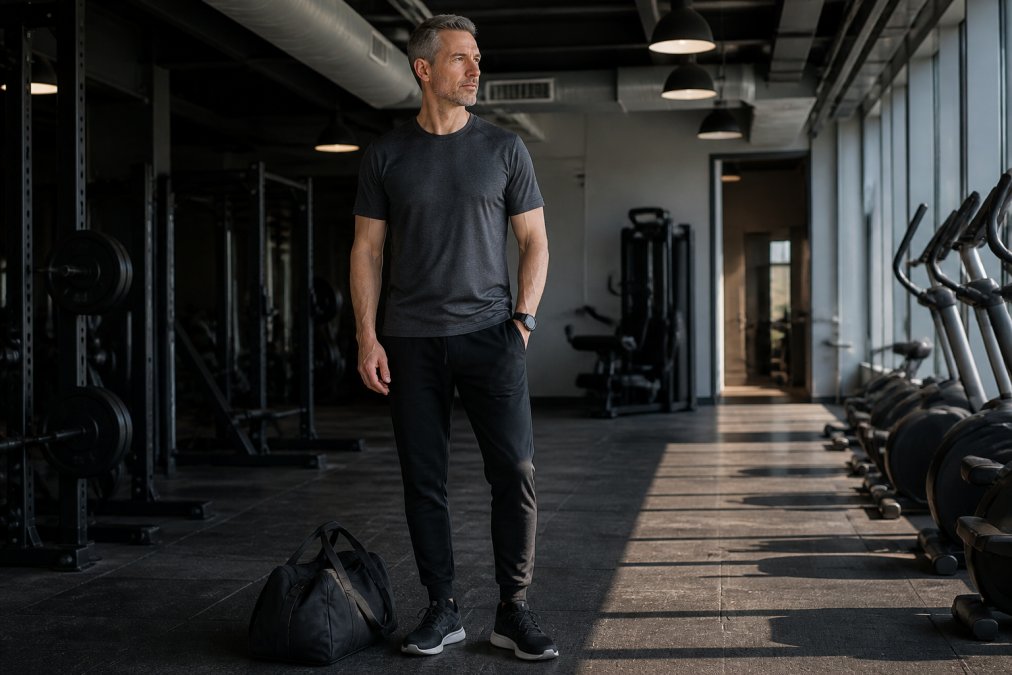
The best gym clothes for men over 40 prioritize joint support, breathability, and a cut that flatters a mature frame rather than a teenage one. Fit and fabric matter more than brand, and the reasons differ from what a 25-year-old needs. Here is what actually matters, and why.
Joint Support and Range of Motion
Tendons and connective tissue lose elasticity with age, and the shoulders, hips, and knees complain first. A shirt that binds overhead or a short that rides up in a deep squat restricts the movement pattern and encourages compensation.
Look for:
- Four-way stretch at the shoulders, hips, and knees. Two-way stretch only moves in one direction and will fight you on compound lifts.
- Gusseted or articulated seams in shorts and joggers. A gusset is a diamond-shaped panel at the crotch that adds room without adding bulk.
- A relaxed, not slim, not oversized, cut. Slim fit restricts; oversized balloons and catches on equipment. You want a fit that skims the body and moves with it.
Skin Sensitivity and Fabric Choice
Skin gets thinner and drier with age, and reactions to synthetic dyes, finishes, and tight weaves become more common. Irritation, itching, or breakouts along seams and waistbands usually trace back to the fabric, not the workout.
Options worth considering:
- Flatlock or seamless construction to eliminate the raised seam that rubs on longer sessions.
- Odor-resistant treatments so a shirt survives a second wear without holding bacteria that irritate skin.
- Natural-fiber blends (organic cotton, bamboo, or cotton-poly) for recovery days and lounging, where breathability matters more than quick-dry performance.
- Tagless labels. Tear-away tags are fine, but a printed label is better, there is nothing to tear and nothing to scratch.
Thermregulation Changes After 40
A man in his late 40s running the same high-intensity session he ran at 30 overheats faster and cools down slower: sweat glands become less efficient and the body dumps heat less effectively. Breathable fabric becomes part of how you manage the session.
That means:
- Moisture-wicking synthetics for anything that makes you breathe hard. They move sweat off the skin so it can evaporate and cool you.
- Midweight layers you can shed rather than one heavy hoodie. A zip-front or quarter-zip lets you vent without stopping.
- UPF protection if you train outdoors. UPF44+ blocks the vast majority of UV and matters more as skin ages.
The Features That Actually Earn Their Keep
Strip away the marketing and a short list remains:
- Moisture-wicking synthetic blends or quality natural fibers, not heavy cotton that soaks and stays wet
- Four-way stretch at the joints that matter
- Seamless or flatlock construction to prevent chafing
- Odor-resistant treatment for multi-wear
- Durable construction at seams, cuffs, and waistbands
- UPF protection for outdoor sessions
Slim-fit and oversized are both wrong defaults after 40. You want a relaxed fit that skims the body without clinging or ballooning, checked against the movements you actually do, not the mirror.
Performance Moisture-wicking T-shirt →
How to Choose Gym Clothes for Comfort and Performance
Comfort and performance are not opposites: the right fabric and fit deliver both. After 40, the trade-offs shift, what felt fine at 30 can leave you overheated, chafed, or restricted at 45. Start with fabric, then fit, then features.
Fabric: Match the Material to the Session
Synthetic blends like polyester move sweat away from skin and dry fast, the right call for high-intensity training, cardio, and heavy sweating. The trade-off: some men find synthetics irritate sensitive skin, especially along seams and waistbands.
Fit: Buy for Movement, Not for the Mirror
Measure your actual chest and waist, not your old size. Bodies change after 40 even when weight stays stable, and a shirt that fit at 38 may bind at 44.
- Shoulders: The seam should sit at your natural shoulder point, no more than an inch past it. Beyond that, the shirt bunches under a barbell and looks sloppy under a jacket.
- Chest and torso: You want a relaxed fit that skims the body. If the fabric pulls across the chest when you reach forward, size up.
- Waistband: A secure, flat waistband that does not roll or dig. Rolled waistbands are a common complaint on longer sessions.
- Length: The hem should stay put when you raise your arms overhead. If it rides up, the shirt is too short or too tight.
Features: The Ones That Matter After 40
- Quick-dry finishes so a shirt is wearable again after a rinse.
- Odor resistance so a piece survives a second wear without holding bacteria.
- UPF protection for outdoor training. UPF44+ blocks the vast majority of UV.
- Flatlock or seamless seams to prevent chafing on longer sessions.
- Tagless or printed labels, nothing to scratch at the neck.
- Durable construction at seams, cuffs, and waistbands, where cheap gear fails first.
For guidance on how much physical activity adults actually need, the CDC physical activity guidelines set the baseline: at least 150 minutes of moderate activity per week plus two strength sessions. Your clothing should support that volume without wearing out.
The Age-Specific Trade-Offs Most Guides Skip
Three things change after 40 and most apparel advice ignores them:
- Thermoregulation. You overheat faster and cool down slower. Breathable fabric and layers you can shed matter more than insulation.
- Skin sensitivity. Thinner, drier skin reacts more to synthetic dyes, finishes, and tight weaves. Try flatlock seams and natural-fiber blends on recovery days.
- Joint support and range of motion. Restricted movement encourages compensation and injury. Four-way stretch and gusseted seams are injury prevention, not luxuries.
Minimalist Gym Apparel That Works From the Gym to the Office
The gym-to-office transition is where minimalist gym apparel earns its keep. One piece, two contexts, no changing room required.
What Minimalist Gym Apparel Costs: A Price Breakdown
Minimalist gym apparel costs more per piece than fast-fashion alternatives, but less per year because it lasts. Here's what a full EVENLIFT rotation looks like:
| Item | Price | Replaces |
|---|---|---|
| Performance Moisture-wicking T-shirt (Unisex) | $39.95 | 3-4 cheap tees |
| Embroidered Premium Fleece Jogger | $69.95 | 2 mid-tier joggers |
| Men's Premium Fleece Shorts | $54.95 | 2-3 cheap shorts |
| Gym Bag | $75.95 | 1-2 failing bags |
Conclusion
The hard part isn't finding minimalist gym apparel. It's committing to fewer, better pieces when the drawer is already full of "good enough."
Frequently Asked Questions
What should a 40-year-old man wear to the gym?
Start with a moisture-wicking t-shirt, midweight joggers or fleece shorts, and supportive training shoes. Choose breathable fabrics with odor resistance and a relaxed or ergonomic fit so nothing restricts your range of motion. A plain color palette keeps the look clean, and durable construction means fewer replacements over time. Two or three well-made pieces cover most weekly sessions.
How does minimalist gym wear improve workout focus?
Fewer choices mean less decision fatigue. When every piece in your rotation fits well and matches everything else, you spend seconds getting dressed instead of digging through a drawer of logos and loud prints. A smaller capsule of quality items also means you notice what actually performs: quick-dry fabric, seamless construction, and a fit that stays put through high-intensity training.
How do I build a capsule gym wardrobe for men without overspending?
Buy fewer, better pieces. Aim for two moisture-wicking t-shirts, one pair of joggers, one pair of fleece shorts, and a durable gym bag, then add a second layer for colder months. Stick to one color family so everything mixes. At EVENLIFT, that core runs from $39.95 for the Performance Moisture-wicking T-shirt to $69.95 for the Embroidered Premium Fleece Jogger, with the Gym Bag at $75.95.
Are there specific fabric technologies better for men over 40?
Look for moisture-wicking synthetics and blends that manage thermoregulation, plus odor-resistant and quick-dry finishes. Four-way stretch and seamless construction support joint support and full range of motion during weightlifting or cardio. Midweight cotton-blend fleece works well for warm-ups and rest days. The goal is breathable fabrics that hold their shape after repeated washing rather than wearing out in a season.